Spinal Rehabilitation For Backs That Have Had Enough
Most back pain does not need surgery or a scan. It needs an accurate diagnosis, the right loading, and someone who will tell you what is actually driving it.
- Spines rehabilitated
- 9,200+ Spines rehabilitated
- Years of spinal practice
- 13+ Years of spinal practice
- Spine-focused therapists
- 7 Spine-focused therapists
- Avoid escalation to surgery
- 91% Avoid escalation to surgery
- Same-day appointments
- No referral needed
- Free 20-min assessment
Find the driver, not just the sore spot
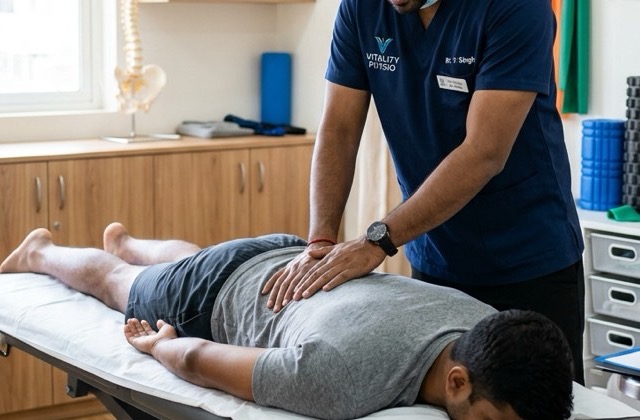
Spinal rehabilitation treats the mechanics around the spine — the hips, the deep trunk muscles, the way you sit, lift and sleep — not only the segment that hurts. Disc bulges and degenerative changes show up on scans of people with no pain at all, so imaging alone rarely explains the problem.
We work out which movements provoke and which relieve your symptoms, use hands-on treatment and traction to settle the irritable phase, then load the spine progressively so it stops flaring at the smallest provocation.
- Clear explanation of what your scan does and does not mean
- Red-flag screening at the first visit — we refer on when it is warranted
- Workstation and lifting technique reviewed, not just exercises prescribed
- Progress re-measured every fourth session against your baseline
From a stiff neck to a stubborn disc
The spinal presentations we see most. If yours is not listed, our team is happy to help.
-
Low Back Pain
Acute and long-standing, with graded loading to rebuild tolerance rather than rest alone.
-

Sciatica
Settling nerve irritation, then restoring the movement that stops it recurring.
-

Disc Herniation & Bulge
Directional preference exercises and decompression to centralise leg symptoms.
-

Cervical Spondylosis
Mobilisation and deep neck flexor work for age-related neck stiffness and headache.
-

Neck Pain & Whiplash
Restoring range and confidence after strain or a road traffic collision.
-
Spinal Stenosis
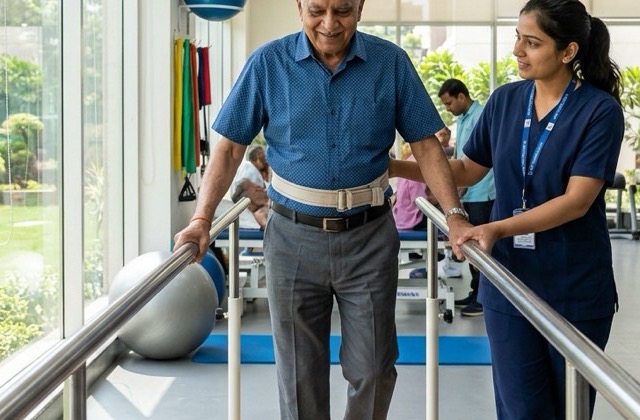
Flexion-based conditioning to extend how far you can walk before symptoms start.
-
Postural Back Pain
For desk-driven pain — workstation changes plus the strength to hold a better position.
-
Post-Spinal-Surgery Rehab
Structured recovery after discectomy or fusion, following your surgeon's technique.
Not seeing your condition? Contact us or call +91 99900 96269.
Settle it, then build it
The irritable phase needs calming. What comes after — capacity — is what stops the next flare.
Book an Appointment-
01
Spinal Mobilisation
Graded hands-on techniques to restore segmental movement and ease guarding.
-
02
Mechanical Traction
Decompression for compressed segments and nerve-related referral into the limb.
-
03
Core Stabilisation
Deep trunk control training that supports the spine through real-world loads.
-
04
Electrotherapy (TENS, IFT)
Short-term pain modulation so active rehabilitation can start sooner.
-
05
Dry Needling
Trigger-point release for the paraspinal and gluteal muscles that guard a sore back.
-
06
Ergonomic Coaching
Desk setup, lifting technique and sleeping position — the hours between sessions.
Four stages, clear milestones
Back pain recovery is not linear, but it is predictable enough to plan. Here is how it runs.
-
1
Initial Assessment
Movement screening, neurological checks and red-flag clearance. You will know whether this needs physiotherapy, imaging or a specialist.
-
2 Weeks 1–2
Settle the Flare
Hands-on treatment, traction and relative rest to bring symptoms down to a workable level.
-
3 Weeks 2–8
Load & Strengthen
Progressive loading of the spine and hips so tolerance rises. Re-measured every fourth session.
-
4 Weeks 8–12
Prevent Recurrence
Discharge with a maintenance programme and the specific triggers to manage in your work and sport.
Stage one costs nothing and takes twenty minutes.
Book your assessmentWhat makes our care different
-
One therapist, start to finish
You are not passed between staff. The physiotherapist who assesses you is the one who treats you through to discharge.
-
Objective progress tracking
Range, strength and function are measured and charted — so "getting better" is a number, not a feeling.
-
Honest session estimates
We tell you upfront roughly how many sessions this should take, and we tell you when you no longer need us.
-
Comprehensive initial assessment
A thorough consultation with a physiotherapist before you commit to anything.
-
Extended evening hours
Appointments until 8:30pm on weekdays so treatment fits around work rather than competing with it.
-
Fully equipped gym floor
Proper loading equipment on site — you cannot rebuild strength with resistance bands alone.
Recovery in their words
1,284 verified reviews
- 5
- 92%
- 4
- 6%
- 3
- 1%
- 2
- 0%
- 1
- 1%
3 recent reviews from this programme
-
Verified
Two years of on-and-off sciatica and three MRI scans. They were the first people to explain what the scan actually meant and what to do about it. Pain free in nine weeks.
Deepak S. Sciatica · 9 weeks -
Verified
I sit at a desk eleven hours a day. Fixing my workstation did more than any of the treatments I had tried before — and they set it up with me rather than handing me a leaflet.
Ritu A. Postural back pain · 7 weeks -
Verified
A surgeon had put me on the list for a discectomy. After twelve weeks of loading work I came off it. Best decision I have made.
Farhan Q. Disc herniation · 12 weeks
Start your own recovery — book your consultation today.
Spine and back pain FAQs
Still unsure? Speak to a physiotherapist on +91 99900 96269 — no charge for the conversation.
Do I need an MRI before starting physiotherapy?
Usually not. Disc bulges and degenerative changes appear on scans of plenty of people with no pain at all, so imaging often does not change the treatment plan. We screen for the specific signs that do warrant a scan, and refer you promptly if we find them.
Is bed rest good for back pain?
Beyond the first day or two it makes things worse. Muscles deconditioning quickly, and the spine becomes less tolerant of load. We keep you moving within a range that does not flare symptoms, then build from there.
Can physiotherapy fix a slipped disc?
A herniated disc frequently resorbs on its own over months. Physiotherapy relieves symptoms, centralises leg pain and restores function while that happens — and rebuilds the capacity that stops it recurring. Severe or progressive neurological signs need a surgical opinion, and we will say so.
How long until my back pain settles?
Acute episodes usually calm within two to six weeks of treatment. Long-standing pain typically takes eight to twelve weeks of progressive loading. You will get a specific estimate at your first consultation.
Will I need to keep exercising after discharge?
A short maintenance routine — usually ten minutes, two or three times a week — is what keeps the gains. We discharge you with it and a plan for handling any future flare yourself.
Do you treat neck pain and headaches too?
Yes. Cervical spondylosis, whiplash and cervicogenic headache are all part of this programme, using the same assessment and loading principles.
Stop planning your day around your back
Book an appointment. You will leave knowing what is driving the pain and roughly how long it takes to settle.
- 1638, Dividing Rd, Sector 65, Faridabad
- info@caringhandsphysioclinic.com
- Open until 8:30pm on weekdays & Saturdays
Book your assessment
Tell us what hurts. We will call you back to confirm a time that works.